Microfluidic
flow cells and bonded manifolds
for precise fluid control and system integration
Custom microfluidic flow cells and manifolds for diagnostics, analytical systems, and semiconductor applications.
Each design is tailored to the specific requirements of the application, ensuring that flow behavior, material compatibility, and manufacturability are aligned from the start.
Discuss your bonding challenge
Defining fluid pathways for accurate and repeatable system performance
Within microfluidic systems, flow cells and bonded manifolds determine how fluids move through the device and interact with functional components such as sensors, reaction zones, or measurement areas.
The design of these structures directly influences:
- Flow distribution across channels or reservoirs
- Dead volume, residence time and mixing behavior
- The accuracy and repeatability of system components, like valves
- Consistency of measurement or reaction conditions
Even small deviations in geometry or alignment can affect system performance, making precision in design and manufacturing essential.
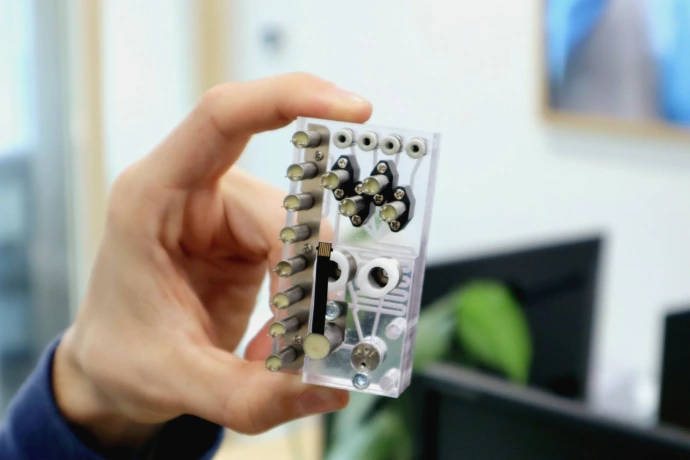
Designing flow cells for controlled interaction with sensing and analytical elements
Flow cells are typically used in applications where fluids must interact with a specific detection or measurement region. This requires careful control over flow stability, channel geometry, and optical or sensing interfaces.
Design considerations include maintaining uniform flow across the sensing area, avoiding dead zones or turbulence, and ensuring that the fluid path supports reliable measurement conditions. Material selection also plays a role, particularly in applications where optical clarity or chemical compatibility is required.
By controlling these factors, flow cells can deliver consistent and reproducible performance across repeated measurements.
Bonded manifolds as a foundation for fluid distribution within fluidic systems
Balancing performance requirements with manufacturability
Flow cells and bonded manifolds are often complex structures that must meet strict performance requirements while remaining suitable for scalable production.
Integration of flow cells and bonded manifolds within complete systems
Flow cells and manifolds do not function in isolation, but as part of a larger fluidic and system-level architecture. Their design must therefore align with surrounding components, including fluidic connections, sensors, and mechanical housings.
Proper integration ensures that:
- Fluid interfaces remain leak-free and stable
- Flow conditions are preserved throughout the system
- Components align correctly during assembly
- System performance remains consistent across multiple units
By focusing on the fluidic component within the broader system, Bondus ensures reliable operation without overextending into full system integration.
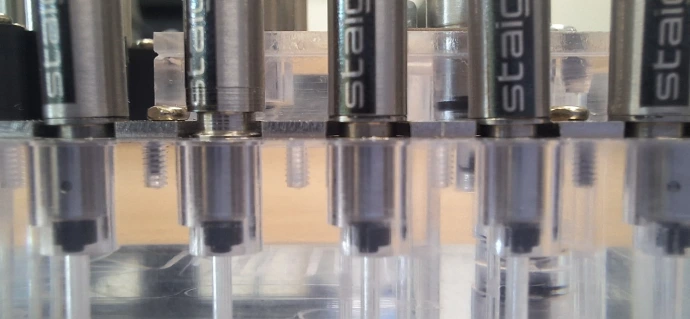
Capabilities in microfluidic flow cell and bonded manifold development
Work in this area focuses on designing and manufacturing microfluidic structures that enable controlled fluid distribution and interaction.
Areas of expertise include:
- Design for manufacturing of flow cells and bonded manifolds
- Multi-layer bonding with integrated flow paths of various materials, including COC, PEI, PMMA, PC and more
- Optimization and accurate machining of channel geometry for stable flow behavior
- Alignment between design and manufacturing processes
These capabilities support both simple and complex architectures.
Applications requiring precise flow control and distribution
Flow cells and manifolds are used in applications where fluid control directly impacts system performance.Examples include:
- Point-of-care
diagnostics
Flow cells enable controlled interaction between samples and detection zones within disposable cartridges. - Lab-on-chip
systems
Manifolds distribute fluids across multiple channels for parallel analysis or processing. - Biosensors
Flow cells ensure consistent exposure of sensing elements to analytes. - Analytical systems
- Stable flow distribution supports accurate and repeatable measurements.
Why Bondus for flow cells and bonded manifolds
Developing reliable flow cells and manifolds requires a combination of material knowledge, design for manufacturability expertise and manufacturing capability.
Bondus focuses on optimizing designs that not only perform under controlled conditions, but also remain stable and reproducible in production. By aligning geometry, materials, and bonding processes, flow behavior can be maintained across devices and batches.
This approach supports both performance and scalability in demanding applications.

Develop
flow cells and bonded manifolds that perform consistently
Reliable fluid distribution is essential for the performance of microfluidic systems. Bondus supports the development and manufacturing of flow cells and manifolds that deliver stable, predictable results.
Frequently asked questions
Questions about flow cells and manifolds
While PMMA (Acrylic) historically is the most commonly used material in bonded manifolds, other material are also employed. Polycarbonate (PC) offers improved chemical resistance and toughness. Cyclic olefin (co)polymers (COC) provide an even better chemical resistance and better optical properties, even in the UV spectrum. Polyetherimide (PEI) is a material often chosen for it's high temperature resistance and mechanical strength.
Alternative materials may be proposed, depending on your application.
A flow cell is a microfluidic structure that directs fluid through a defined region where interaction with sensors or analytical elements takes place.
A manifold distributes fluids across multiple channels or pathways within a microfluidic device, enabling controlled routing and parallel processing. Bonded manifolds are built up from multiple material layers to allow for complex channel layouts.
Uneven or unstable flow can lead to inconsistent results, making precise control over fluid pathways essential for reliable system performance.