Microfluidic CNC machining
Precision-machined polymer components
CNC machining is one of the technologies Bondus uses to manufacture high-precision microfluidic components. With a selection of end mills, drills and engraving tools, we can create complex fluidic pathways with features as fine as 0.05 mm—smaller than the width of a human hair.
Our machining capabilities support fast prototyping and small production series. For certain products, including multilayer manifolds, CNC machining can also remain suitable at larger production volumes. By combining precision machining with microfluidic bonding and micro-dispensing, Bondus can support the complete manufacturing process.
Discuss your machining requirements Explore our capabilities
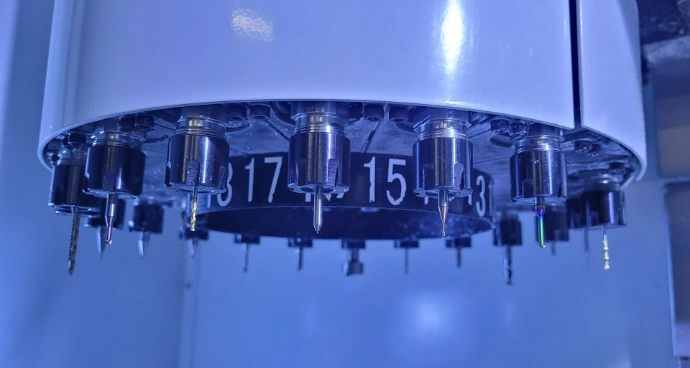
CNC milling of polymer components
CNC milling is a material-removal process in which a cutting tool creates channels, pockets, threads and other functional features directly in the material. Unlike processes that require dedicated moulds, CNC milling makes it possible to manufacture prototypes and product variations without first investing in product-specific production tooling.
This makes CNC machining particularly suitable for design iteration cycles in which a part must be produced, tested and refined before the production process is scaled up.
Bondus uses CNC precision milling for:
- Microfluidic devices
- Flow cells
- Multilayer manifolds
Precision milling for reliable bonding
The quality of a machined microfluidic part is not determined by its microfeatures alone. Surface finish and flatness also influence whether the part can be bonded reliably in a later manufacturing step.
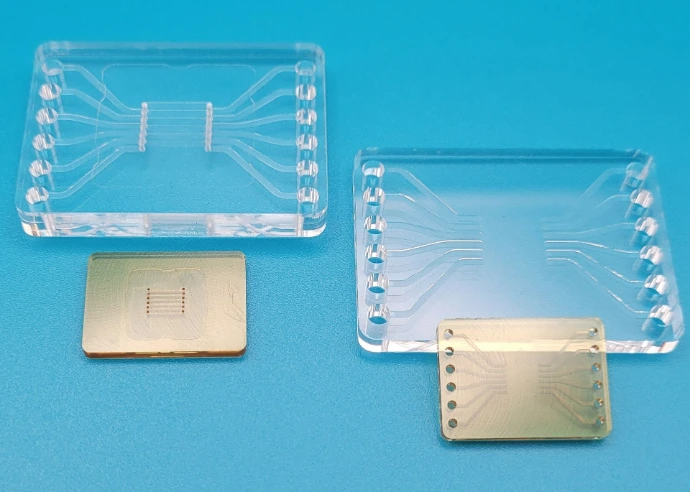
Bondus mills polymer parts to the flatness requirements needed for subsequent bonding and functionalization steps. Depending on the application, machined parts can be bonded to other polymer components or integrated with glass or silicon parts.
Keeping machining and bonding requirements aligned helps prevent unreliable seals, channel deformation and inconsistent device performance.
Micro-sized features and optical surface quality
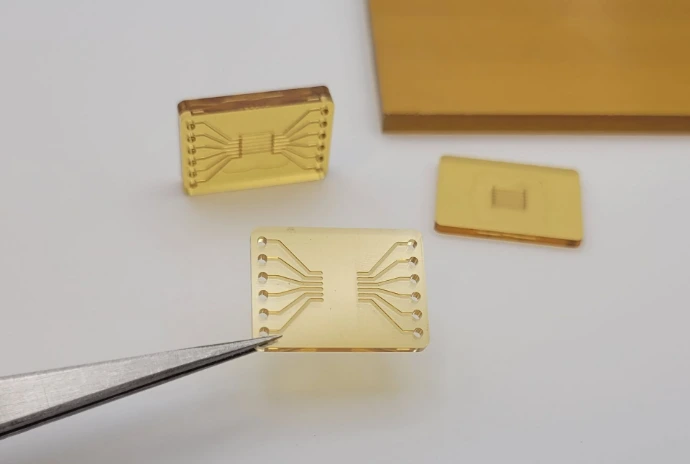
The minimum feature size achievable by milling depends on several factors, including the cutting tool, channel geometry, material properties and required tolerances. CNC milling is generally suitable for channel dimensions down to approximately 100 µm. Depending on the material, geometry and application requirements, features as small as 50 µm may also be achievable.
Where optical transparency is important, Bondus can achieve high optical surface quality in transparent polymers, including on the surfaces of milled channels. This makes precision CNC milling well suited for microfluidic components featuring optical windows or transparent channels for microscopy and imaging applications.
The feasibility of specific channel dimensions, tolerances and surface quality is assessed for each individual part and application.
From prototype to repeatable production
CNC machining is particularly suitable when you need a functional prototype without investing in mould tooling. It also offers the flexibility to make multiple design iterations and test different product variations quickly.
For small series and recurring production, CNC machining provides a flexible and cost-effective manufacturing route, especially when design changes or lower volumes are expected.
As volumes increase and the design becomes stable, other production technologies such as injection moulding may become more suitable. Bondus can support this transition, helping you move from a machined prototype to a reproducible microfluidic product and select the right manufacturing approach for each stage of development.
This approach is suitable for companies developing products for:
- Point-of-care diagnostics
- Lab-on-chip systems
- Organ-on-chip systems
- Bioreactors
- Photonics
- Other biotech and life-science applications
Discuss your machining requirements
Looking for a manufacturing partner for a microfluidic product?
Share your material requirements, dimensions and expected production volumes with the Bondus team. We’ll help you determine the most suitable manufacturing approach for your project.
Why Bondus for micro-machining?
In-house CNC machining
In-house CNC machining enables short communication lines and fast turnaround for prototypes and small series.
Microfluidic manufacturing expertise
Bondus combines precision milling with knowledge of polymer processing, microfluidic bonding, micro-dispensing, assembly and production automation.
Prepared for the next manufacturing step
Parts are machined with subsequent bonding, functionalization and integration requirements in mind.
Quality-controlled production
Bondus manufactures products in controlled conditions, supported by ISO 7 cleanroom facilities and an ISO 13485 quality management system.
Flexible production volumes
Our manufacturing platforms support prototypes, small series and the transition towards recurring production.
Frequently asked questions
Questions about microfluidic CNC machining
CNC milling is generally suitable for channel dimensions down to approximately 100 µm. Depending on the material, geometry, cutting tool and required tolerances, features as small as 50 µm may be achievable.
Yes. CNC machining is particularly suitable for manufacturing functional prototypes, design iterations and small production series because it does not require dedicated mould tooling.
Injection moulding may become more suitable when a design is stable and production volumes increase. Bondus can help determine this transition point and the right manufacturing technology for each stage of your product.