
Bonding is a critical manufacturing step for many microfluidic devices. Once microchannels and other microstructures have been created, separate layers often need to be joined to form an enclosed and leak-tight fluidic network.
The challenge is to create a reliable bond without significantly deforming microstructures, blocking channels or affecting the function of the device. Technologies such as thermal bonding can provide one route for joining polymer layers, but the appropriate solution always depends on the specific materials, geometry and application.
Selecting the bonding strategy early in the development of the device can also prevent a situation in which a functional prototype becomes difficult or inefficient to manufacture repeatedly at scale. Bonding should therefore be considered as part of the complete manufacturing route rather than simply as the final assembly step.
Why is bonding critical in microfluidic devices?
The selected bonding process can influence:
- microstructure integrity
- pressure resistance
- optical properties
- (bio-)chemical compatibility
- alignment of the layers
- long-term reliability
- scalability of production
A mechanically strong bond is therefore not automatically a suitable microfluidic bond. The microstructures also need to retain the geometry and functional properties required for the application.
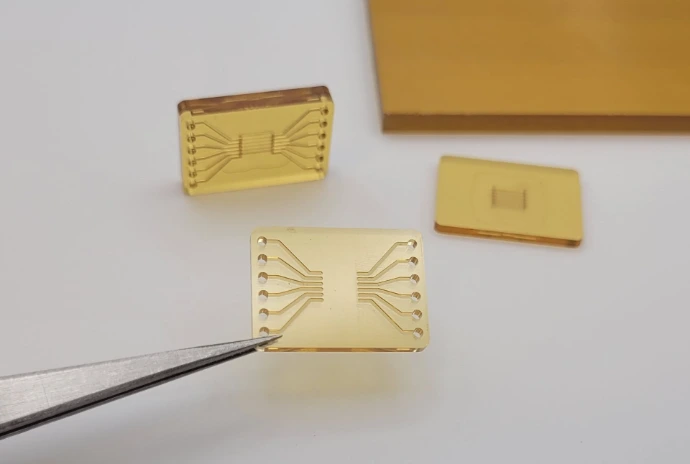
Which bonding technologies are used for microfluidic devices?
There is no single bonding technology that suits every microfluidic device.
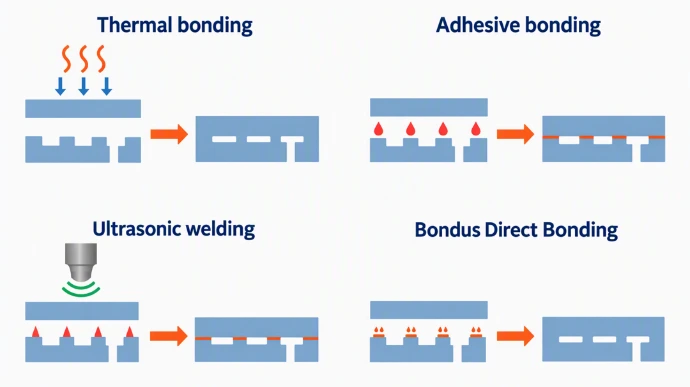
Different polymer types, microstructure dimensions, and production requirements may call for different bonding approaches. Relevant bonding technologies for polymer-based devices include:
- Thermal bonding
- Adhesive bonding
- Ultrasonic welding
- Bondus Direct Bonding
The key question is therefore: Which bonding technology best fits the specific application?
The manufacturing team needs to determine which bonding method provides the right combination of sealing performance, material compatibility, geometry preservation, and production efficiency for the specific component.
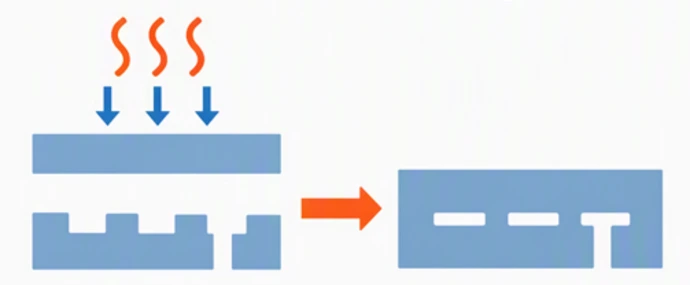
Thermal bonding
Small channels, thin walls and other features can potentially deform if process conditions are not controlled sufficiently. The appropriate parameters depend on factors such as:
- polymer type and glass transition temperature
- component thickness
- microstructure dimensions
- surface condition
Thermal bonding can therefore be effective for suitable polymer combinations, but the bonding conditions need to be compatible with both the material and the microfluidic geometry.
Thermal bonding
Adhesive bonding
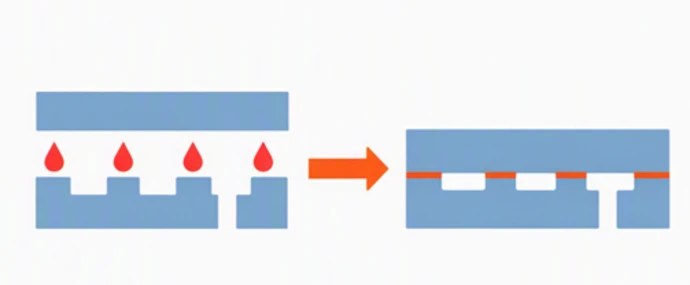
A major advantage of adhesive bonding is its flexibility. It can bond layers made from different polymer grades or integrate functional components using a single adhesive.
The main challenge is controlling where the adhesive is applied.
In a microfluidic device, excess adhesive near a microchannel can potentially affect its geometry or come into contact with fluids flowing through the device. Adhesive selection must therefore take into account the chemical environment and the biofunctional requirements of the application.
Accurate adhesive dispensing and controlled curing are therefore important parts of the process.
Adhesive bonding
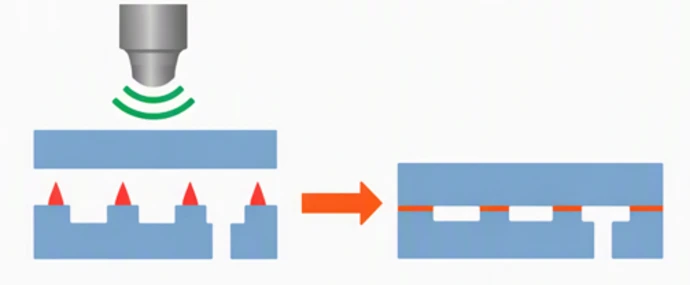
Ultrasonic welding
The process can provide relatively short joining cycles, making it well suited to applications where production efficiency and automation are important.
However, ultrasonic welding places specific requirements on component design.
Features that concentrate the welding energy, so-called energy directors, may need to be incorporated into the geometry. Material compatibility, weld locations, and the proximity of sensitive microfluidic structures also need to be considered.
For this reason, the decision to use ultrasonic welding is ideally made before the component design is fully finalized.
Ultrasonic welding
Bondus Direct Bonding
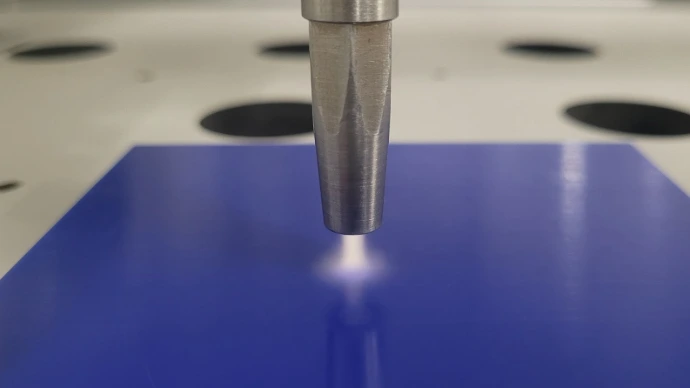
This technology was developed by Bondus specifically for polymer microfluidic components. It uses a material-specific, non-toxic bonding agent that is applied with high accuracy around the microfluidic structures. The layers are brought together and the bonding agent is activated, creating a permanent bond without leaving an intermediate layer.
Direct bonding can be attractive when additional adhesive layers inside the finished component are undesirable.
With cycle times comparable to ultrasonic welding, the process is well suited to applications where high production throughput is important.
Bondus Direct Bonding

How do you choose the right bonding technology?
Choosing the appropriate bonding technology requires considering the complete set of product and manufacturing requirements.
Useful questions include:
- Which materials need to be bonded?
- How small and sensitive are the microstructures?
- Is optical transparency important?
- Which chemicals, samples, or reagents will come into contact with the bonded surfaces?
- Are any temperature-sensitive materials integrated before bonding?
- What internal pressures are expected?
- Do membranes, sensors, or other components also need to be integrated?
- How important is bond strength?
- What production volumes are required?
- Will automation become important as production volumes increase?
The right bonding technology therefore depends not only on the functional requirements of the component, but also on the production stage, expected volumes, and manufacturing route.
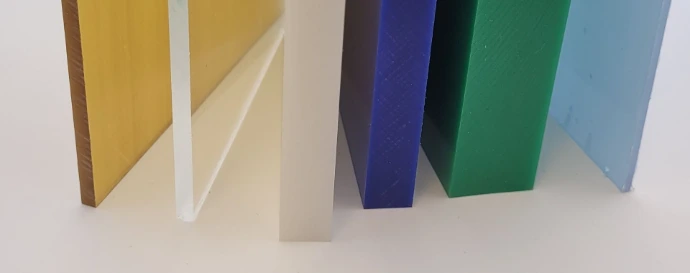
How does material selection affect bonding?
For this reason, material selection and bonding strategy are best considered together rather than as separate, sequential decisions.
Why does channel geometry matter during bonding?
The position of the channels relative to the bonding area also matters. Sufficient surface area is needed to create a reliable seal without unnecessarily increasing the component footprint or interfering with the fluidic structures.
Alignment is another important factor in multilayer devices. Channels, ports, and functional regions in different layers need to remain correctly positioned relative to one another after bonding.
Considering these requirements early in the design process reduces the likelihood that the final geometry becomes unnecessarily difficult to bond.
What about surface treatment before bonding?
Surface condition can influence how materials behave during subsequent bonding steps.
As with the bonding technology itself, surface treatment should therefore be selected based on the specific requirements of the component and manufacturing process.
Bonding prototypes versus production components
During prototyping, flexibility and short lead times usually matter most. Designs can still change, and often only a small number of parts is needed to test whether the device works as intended. A bonding process that enables fast prototyping might therefore be the most suitable choice at this stage.
As production quantities increase, however, priorities can shift towards:
- repeatability
- process control
- cycle time
- inspection criteria
- automation
This does not automatically mean that the bonding technology used during prototyping needs to be replaced. It means that the existing process needs to be evaluated against the future production requirements. If it remains repeatable and efficient at the required quantities, it may continue to be suitable. If not, the manufacturing route can be adjusted before volumes increase further.
Therefore, production requirements are an important factor when selecting the appropriate bonding technology.
Bonding by Bondus
Bondus offers all bonding technologies discussed in this article and integrates them with the surrounding manufacturing processes, from prototyping through volume production.