Point-of-care (POC) diagnostics make it possible to perform medical tests at or near the location where patient care is provided. Instead of relying exclusively on centralized laboratory infrastructure, point-of-care systems are designed to bring testing closer to the patient and support faster access to diagnostic information.
Microfluidics is an important enabling technology for many of these systems. By controlling small volumes of samples and reagents within precisely engineered channels, several fluid-handling and analytical functions can be incorporated into a compact device.
For manufacturers of diagnostic systems, however, proving that a microfluidic concept works is only part of the challenge. Materials, channel geometry, bonding, surface characteristics, assembly and production repeatability can all influence whether the microfluidic component can be manufactured consistently.
What is point-of-care diagnostics?
Point-of-care (POC) diagnostics refers to medical testing carried out directly alongside the patient, whether at the bedside, in a clinic, or in another care setting. By moving analysis out of central laboratories and closer to the patient, these approaches ease the burden on laboratory staff while shortening the time to results and enabling more immediate clinical decision-making.
Depending on the application, testing can take place in hospitals, clinics, doctors' offices, pharmacies or home environments. Examples of point-of-care testing include blood glucose monitoring, pregnancy testing and certain infectious disease tests.
The exact architecture differs considerably between diagnostic systems. Some are simple disposable tests, while others combine a disposable cartridge with a reusable reader or instrument.
A common objective is to perform the required diagnostic process in a compact and practical format. This is one area where microfluidic technology can play an important role.
Why is microfluidics used in point-of-care diagnostics?
A microfluidic cartridge can support a range of functions:
- sample transport
- sample preparation
- mixing
- separation
- reagent handling
- reaction steps
- delivery to a detection area
Working with small internal volumes can also reduce the amount of sample and reagents required.
Another important characteristic is control. Precisely defined channels can determine how fluids are routed through the cartridge and brought into contact with reaction or detection areas.
Microfluidics does not determine the diagnostic method itself. Instead, the microfluidic component provides the physical fluid-handling environment needed to support the wider diagnostic system.
What does a microfluidic diagnostic cartridge do?
Many point-of-care platforms combine a disposable cartridge with a reusable instrument.
The cartridge can contain the fluidic structures required to guide samples and reagents through different stages of the diagnostic process. Depending on the application, it may also contain sensors or electrodes that connect with the reader.
This means the cartridge needs to interact correctly with the rest of the system. Ports and interfaces need to align, fluids need to follow the intended pathways and the cartridge needs to provide the required conditions around the detection area.
Because single-use cartridges cannot be tested without being destroyed, manufacturing consistency is essential. In-line quality controls, such as optical/vision inspection or measurement of chamber and channel depths, help ensure that every cartridge meets design tolerances and performs as intended.
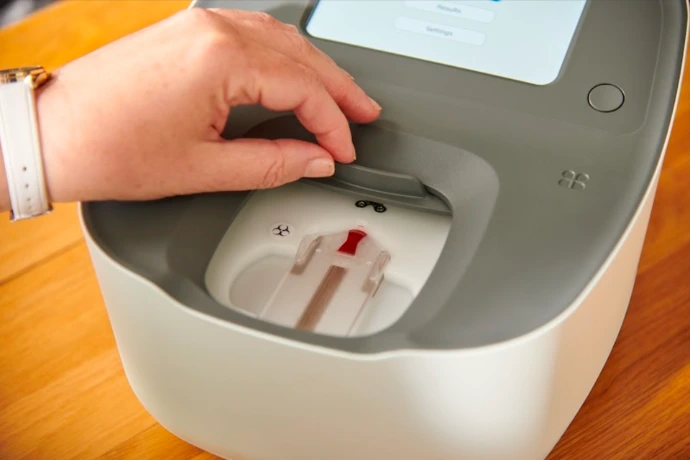
Examples of microfluidics in point-of-care testing
The exact role of microfluidics differs according to the diagnostic technology.
Disposable diagnostic cartridges
Disposable diagnostic cartridges are small, single-use devices used in medical testing to analyze a sample, such as blood, urine, or saliva, and produce a diagnostic result.
Disposable cartridges can integrate several fluid-handling functions within one component or assembly. Sample collection and sample preparation are distinct steps. Even if the user collects the sample, the cartridge may integrate functions such as metering, filtration, mixing, reagent storage, and delivery to the detection zone.
For these products, repeatability is particularly important, as cartridge-to-cartridge variations can affect measurement accuracy, precision, and the reliability of diagnostic results.
Infectious disease testing
Microfluidic cartridges can transport a sample through preparation, reaction and detection stages.
In molecular diagnostic applications, for example, the fluidic network can support several operations needed to prepare and analyse the sample. The actual assay and detection technology determine which functions need to be incorporated into the cartridge.
Biosensor-based diagnostics
Microfluidics can also be combined with optical, electrochemical and other sensing technologies.
The fluidic component guides the sample towards the relevant sensing area and helps control the conditions under which the interaction takes place.
This connection between fluid handling and detection means microstructure geometry and sensor interfaces can become important manufacturing considerations.
What are the main manufacturing challenges?
Key considerations for manufacturability include:
- Microstructure geometry — microstructure dimensions, and manufacturing tolerances
- Material selection — biocompatibility, chemical resistance, optical properties
- Surface treatment — coatings for wetting, anti-fouling, or reagent immobilization
- Bonding technology — thermal, adhesive, ultrasonic bonding, Bondus Direct Bonding
- Optical requirements — transparency of material or addition of detection windows
- Reagent storage — stability, shelf life, lyophilization, liquid reagent reservoirs
- Fluidic interfacing — sample introduction ports, air venting, dead-volume control
- Active/passive components — integration of valves, pumps, membranes, electrodes, filters
- External interfacing — mechanical, electrical, optical, and thermal connection to cartridge components and/or the reader instrument
- Assembly — assembly sequence and possibilities for automation
- Sterilization — sterilization method and bioburden control
- Packaging and storage — moisture and light protection, desiccants, storage conditions
- Scalability and cost — cycle time, tooling, throughput, cost per unit
- Quality control — inspection methods during and after production
- Regulatory requirements — IVDR, ISO 13485
Which characteristics are critical depends on the diagnostic application.
A cartridge using optical detection, for example, can place specific requirements on transparency of optical areas. Another diagnostic system may place greater emphasis on chemical or thermal resistance.
Manufacturing requirements therefore need to be based on the actual function of the component rather than applying the same specifications to every point-of-care device.
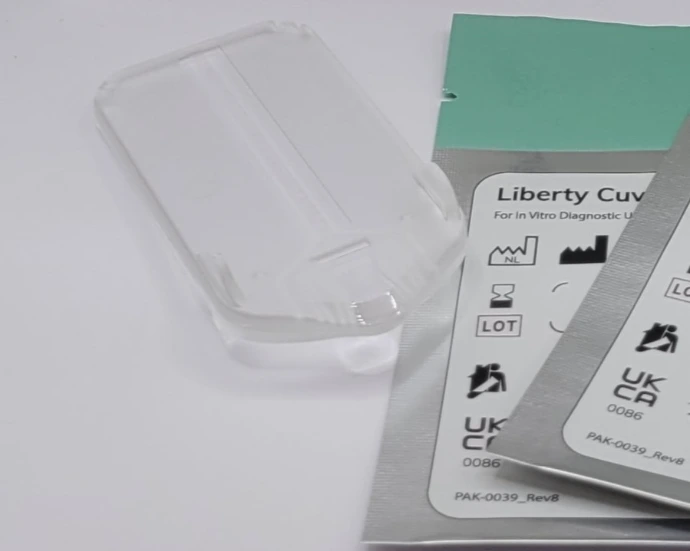
The microfluidic component within the complete diagnostic system
Manufacturing microfluidic components for point-of-care diagnostics
Bondus manufactures polymer microfluidic components for diagnostic applications from physical prototypes towards repeat production.
Working on a point-of-care platform? Explore our point-of-care diagnostics capabilities to learn more about manufacturing microfluidic components for these applications.